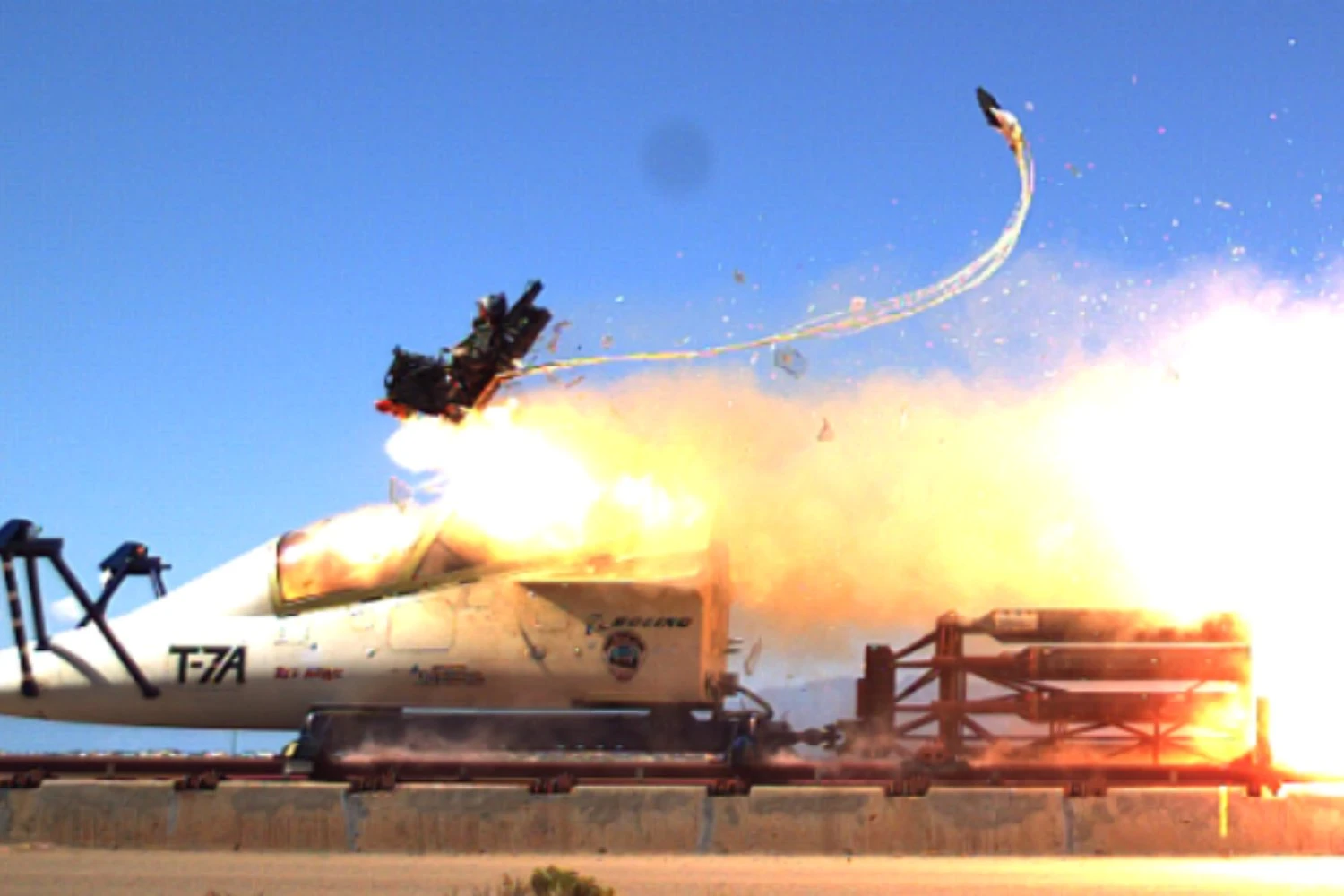
One of the problems that contributed to years of delays in the Boeing T-7A Red Hawk program may finally be approaching a resolution. The U.S. Air Force has completed the final high-speed sled test planned for the jet trainer's escape system qualification campaign.
The test was conducted on October 7 at the Holloman High Speed Test Track in New Mexico by the 846th Test Squadron. It simulated an ejection at an effective airspeed of 550 knots and used an anthropomorphic test device representing the lightest occupant in the pilot candidate range.
Initial analysis of high-speed video indicated that the upgraded system operated as intended, although engineers are still reviewing seat trajectory, acceleration and biometric sensor data before completing the qualification process.
The latest test evaluated a redesigned canopy-fracturing pattern and a modernized ejection seat sequencer. The latter changes the timing of the escape sequence, keeping the stabilizing drogue parachute deployed longer to stabilize the seat and reduce peak loads on the occupant's neck and spine.
Problem that helped delay the T-7A
Problems with the escape system emerged as one of the major obstacles during development of the T-7A, which Boeing developed with Saab to replace the U.S. Air Force's aging T-38C Talon fleet.
In 2023, the Air Force acknowledged that ejection-seat issues were contributing to a delay that pushed the first production aircraft into the middle of the decade. Testing had identified risks including concussion and potentially excessive forces on the neck and spine, particularly for smaller and lighter pilots.
Follow Air Data News: WhatsApp | Instagram | LinkedIn | Twitter | Facebook
The issue was especially challenging because the T-7A was designed to accommodate a wider range of pilot body sizes than previous Air Force trainers. The service wanted the escape system to safely accommodate occupants weighing from 103 to 245 lb (47 to 111 kg).
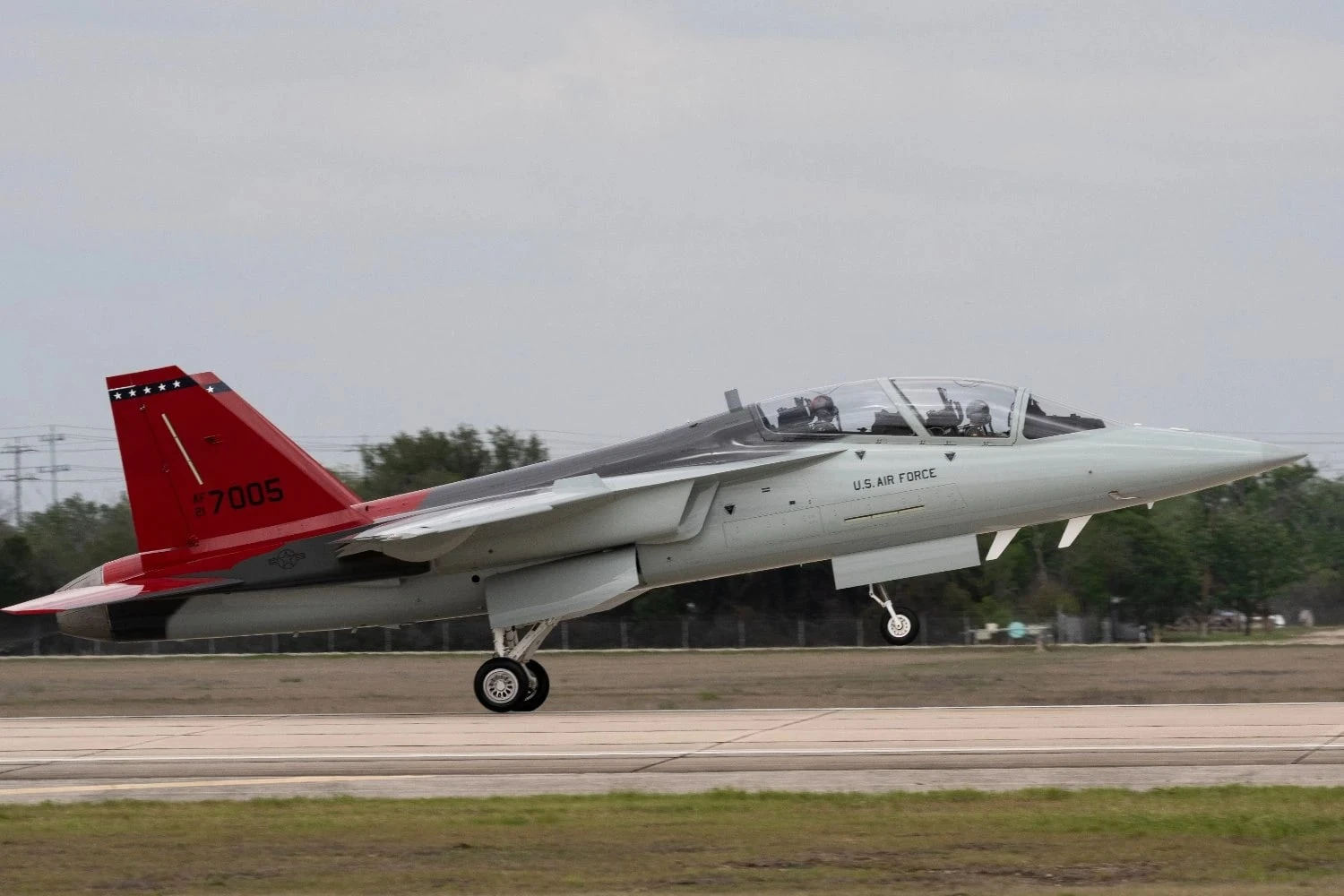
A 2024 report from the Pentagon's Director, Operational Test and Evaluation said the T-7A emergency escape system did not meet the minimum safety requirements for Air Force airworthiness certification and that the aircraft was operating under a high-risk airworthiness acceptance. The Government Accountability Office also identified escape-system safety concerns as a factor continuing to drive program delays.

The Air Force and Boeing subsequently modified the system through a series of tests. Changes included the new canopy-fracturing system and revisions to the ACES 5 ejection seat, including the operation of its drogue parachute and sequencing system.
Final test in qualification campaign
A previous high-speed sled test in April 2025 simulated an ejection at 450 knots using both lighter and heavier test mannequins. The Air Force said that test met all objectives but made clear at the time that another test would be required before the escape system could be fully qualified.
The October run completed that planned series of static and dynamic sled tests. This time, engineers concentrated on the lightest occupant in the required pilot range and increased the simulated airspeed to 550 knots.
According to the Air Force, an initial review showed that the upgraded sequencer performed as designed. Formal engineering analysis of the test data is continuing, meaning completion of the sled campaign should not yet be interpreted as final qualification of the escape system.

The milestone comes as the wider T-7A program has begun moving beyond development. In May, the Air Force approved low-rate initial production following the Milestone C decision and awarded Boeing $219 million for the first 14 production aircraft.
Operational testing has also begun. In July, developmental and operational test crews conducted their first joint T-7A sortie at Edwards Air Force Base, California, as the service works toward introducing the new trainer into its pilot training system.
The Air Force plans to acquire up to 351 T-7As together with ground-based training systems to replace the T-38C, which has served as its advanced jet trainer for more than six decades.