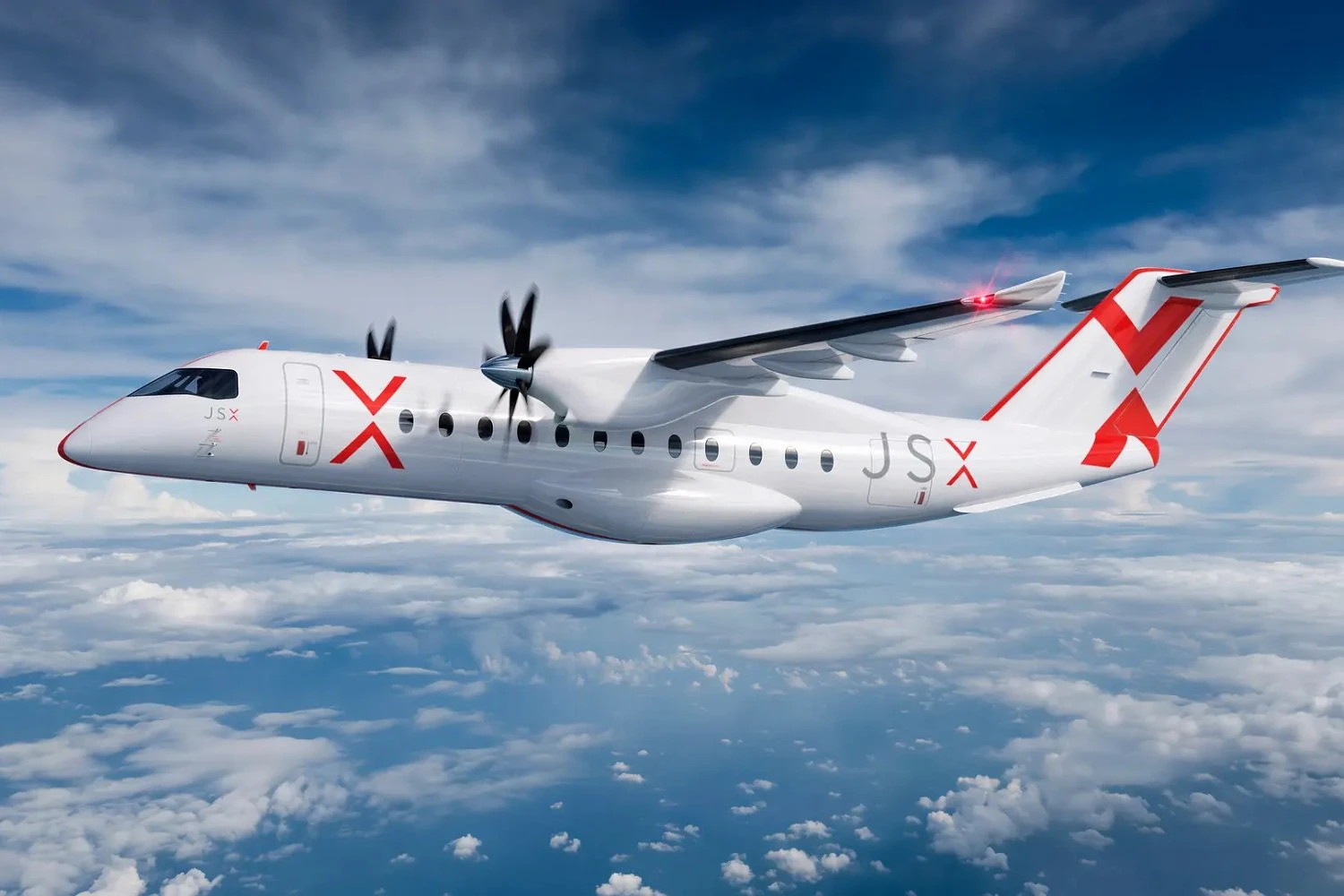
Heart Aerospace has replaced its ES-30 with a new 36-seat hybrid-electric aircraft, the ES-36, less than two months after the full-scale demonstrator developed around its previous design completed its first flight.
The Swedish-founded company unveiled the ES-36 on Wednesday alongside a purchase agreement with US carrier JSX. The deal covers 50 aircraft backed by a deposit and purchase rights for another 50.
JSX had previously signed a letter of intent in 2023 for 50 ES-30s, with options for another 50. The new agreement therefore transfers the carrier's commitment to the aircraft that Heart now intends to take through certification and into production.
The first pre-production ES-36 is being built at Heart's pilot manufacturing plant in Torrance, California, with its maiden flight targeted for the second half of 2028. Entry into service is planned for 2031.
Two propellers replace four-engine ES-30 configuration
The ES-36 retains the basic concept of using batteries for short flights and a hybrid system for longer sectors, but substantially changes how the propulsion system works.
Instead of the four-propeller configuration proposed for the ES-30, the new aircraft has two propellers, each driven by a 1.65 MW electric motor. For longer flights, two small gas turbines operate as turbogenerators, supplying electricity rather than mechanically driving the propellers.
Heart describes the arrangement as a series-hybrid architecture. The aircraft is designed to carry 36 passengers, six more than its predecessor, while providing an additional 1,415 lb (642 kg) of payload without increasing maximum takeoff weight or battery capacity.
Follow Air Data News: WhatsApp | Instagram | LinkedIn | Twitter | Facebook
The company claims an all-electric range of 125 miles (200 km), including reserves, and a hybrid range of 745 miles (1,200 km). The ES-30 had been advertised with the same electric range but approximately 500 miles (800 km) using its hybrid system.
The redesign also reduces wingspan by around 11 feet to 95 feet. Heart says experience obtained from designing, building, ground-testing and flying its X1 demonstrator contributed to the new configuration.

X1 flew only weeks before ES-30 was dropped
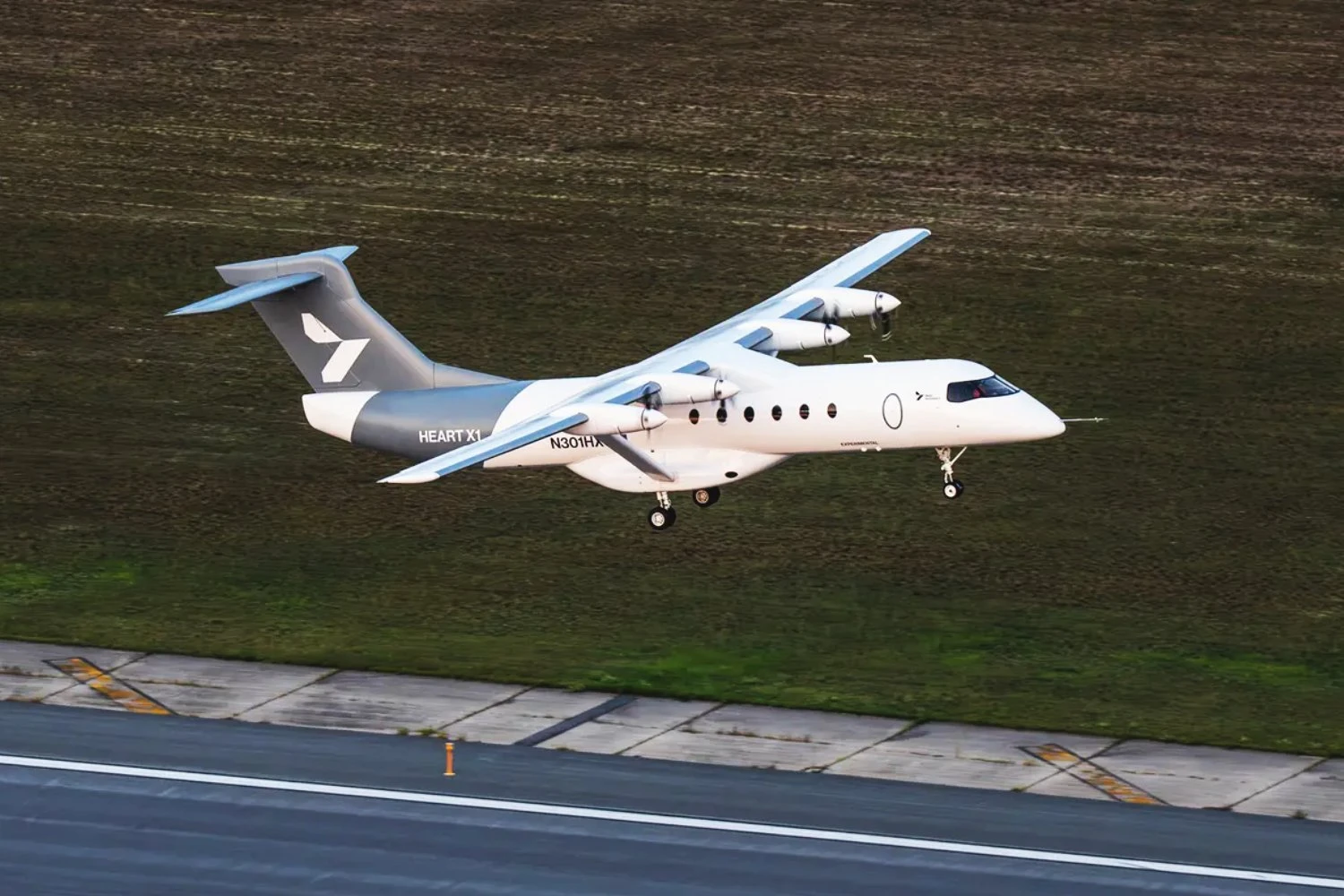
The transition is particularly notable because Heart was still publicly presenting the ES-30 as its production aircraft when the X1 made its maiden flight on August 12.
The full-scale demonstrator flew for 27 minutes from Plattsburgh International Airport in New York, reaching approximately 1,100 feet above ground level. Although built around the size and configuration of the ES-30, the X1 was an experimental battery-electric aircraft rather than a certification prototype of the proposed airliner.
Heart built the X1 in Gothenburg, Sweden, before moving the aircraft to the United States for flight testing. The company subsequently closed its Swedish operations and concentrated its activities in the United States, with its headquarters now in the Los Angeles area.
The development roadmap once included another aircraft called X2. When Heart unveiled the X1 in 2024, it said the X2 would be a pre-production prototype incorporating the hybrid-electric system and was expected to fly in 2026.

Third commercial aircraft design since 2020
The ES-36 is the third substantially different commercial aircraft proposed by Heart since the company emerged with plans for an electric regional airliner.
Its first design was the ES-19, unveiled in 2020 as a 19-seat all-electric aircraft. It featured four electric propellers suspended from the wing on prominent mounting structures and was initially expected to enter commercial service in the second half of the decade.
The project attracted major airline interest before an aircraft had flown. United Airlines and Mesa Air Group announced plans in 2021 to acquire 100 ES-19s each, subject to safety, operational and commercial requirements, while United also secured options for another 50.
Heart abandoned that configuration in September 2022 and introduced the ES-30. The larger aircraft increased capacity to 30 passengers and added hybrid propulsion to overcome some of the range limitations associated with batteries.
Existing customers were moved to the new design. United and Mesa reconfirmed their commitments for the ES-30, while Air Canada became an investor and placed an order for 30 aircraft. Saab also invested in Heart at the time.
The latest redesign repeats that process with a larger cabin and another propulsion architecture. Heart describes its development strategy as iterative, using full-scale hardware and flight testing to feed lessons into subsequent designs rather than freezing the configuration early in the program.