The US Air Force expects to continue using its Northrop T-38 Talon jet trainers until 2037 or 2038, more than a decade from now, despite the introduction of the Boeing T-7A Red Hawk. The extended transition involves the time required to produce and deploy enough of the new aircraft to replace a fleet that has been operating since the early 1960s.
Lieutenant General Clark J. Quinn, commander of Air Education and Training Command (AETC), confirmed the timeline during a meeting with reporters on November 16. According to Air & Space Forces Magazine, the general acknowledged that keeping the T-38 operational for another decade will be challenging, but said the service believes the aircraft can remain in use.
The Air Force currently operates approximately 490 T-38s, with an average age approaching 60 years. Quinn said the fleet achieves a mission-capable rate of only about 50%, meaning roughly half the aircraft are available to perform their assigned missions at a given time.
The aging trainers have become increasingly difficult to maintain. Their two General Electric J85-GE-5 turbojet engines require repeated overhauls, replacement components are harder to obtain, and the aircraft are no longer in production. Quinn said most of the recent engine-related problems have been resolved, although he does not expect the overall availability rate to improve significantly.
Follow Air Data News: WhatsApp | Instagram | LinkedIn | Twitter | Facebook
The Air Force has also invested in keeping the Talon operational. Earlier in 2026, Boeing received a contract worth approximately $900 million to sustain the T-38's avionics through March 2036.
T-7A faces tight schedule
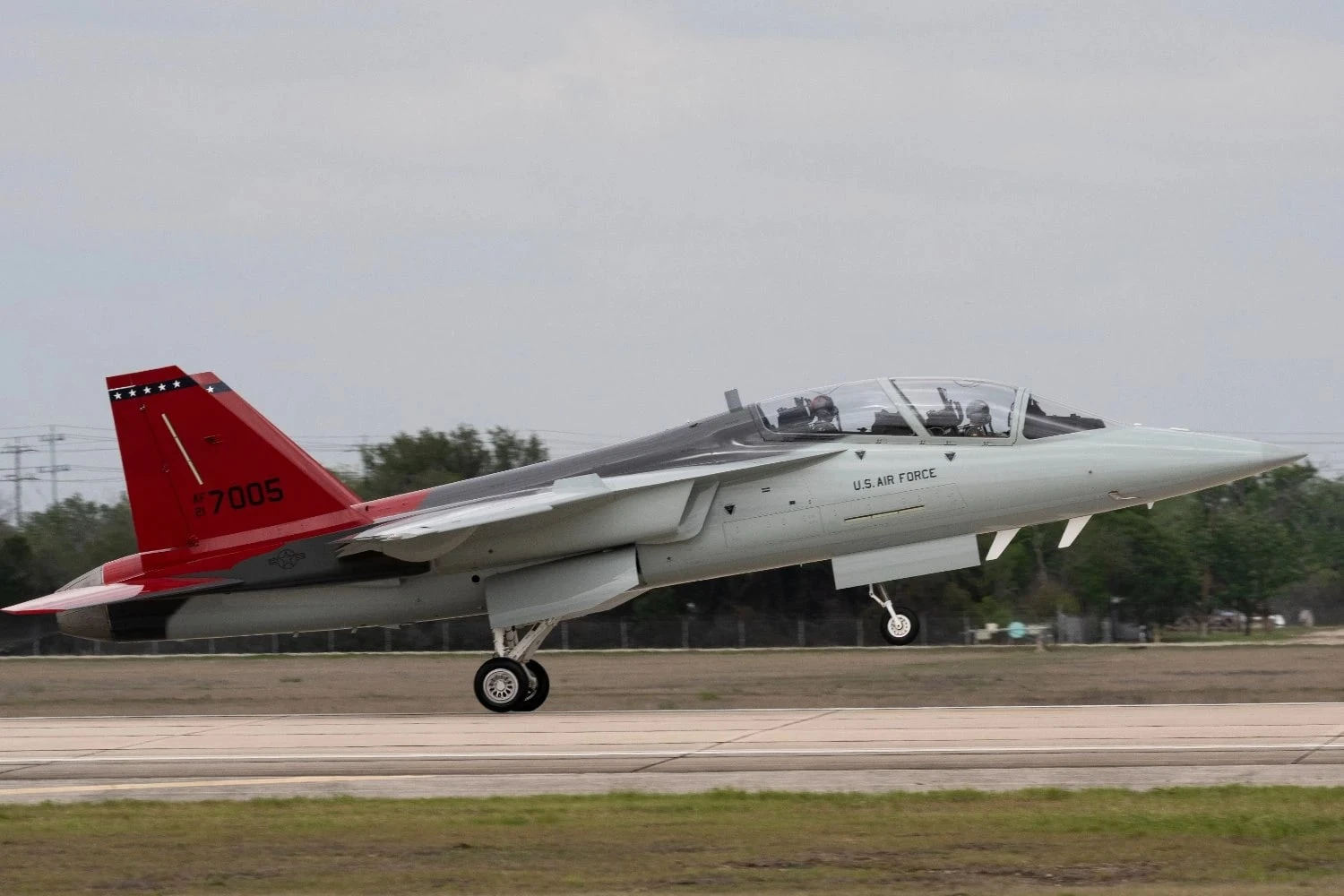
The T-7A Red Hawk is intended to replace the T-38 in advanced pilot training, preparing students for modern fighters such as the F-35 Lightning II and F-22 Raptor. Developed by Boeing and Sweden's Saab, the aircraft features digital flight controls, modern cockpit displays and training systems designed to reproduce the demands of operating contemporary combat aircraft.

The Air Force approved low-rate initial production of the T-7A in April 2026, authorizing the first batch of 14 aircraft. The program calls for 351 trainers and 46 ground-based training simulators, with deliveries to five AETC bases.
However, the introduction of the new aircraft remains slow. AETC has received only three T-7As so far, and one is currently being used to train maintenance personnel rather than conducting flights. See also: Red Hawk program
The service is targeting August 2027 for initial operational capability (IOC), the point at which the aircraft would be ready to begin performing a defined set of training missions. Quinn acknowledged that meeting this deadline remains uncertain.
According to the commander, three conditions must be fulfilled before the T-7A reaches IOC: delivery of 14 aircraft, certification of 14 instructor pilots and expansion of the aircraft's approved flight envelope to permit the maneuvers required for training.
Related news


November 16, 2026
November 15, 2026
AETC currently has eight pilots qualified to fly the T-7A, but the aircraft has not yet been cleared for all the missions instructors will eventually need to conduct. Flight testing continues to progressively expand its operating limits.
The program has already experienced delays involving software development, ejection-seat performance, aircraft availability and supply-chain difficulties. A July 2026 assessment by the US Government Accountability Office (GAO) indicated that most developmental testing would continue until April 2028, with some lower-priority requirements extending into 2029.
T-38 retirement will be gradual
The expectation that T-38s will remain in service until the late 2030s does not mean the entire fleet will continue flying until then.
According to Pentagon force-structure projections released with the fiscal 2027 budget, the Air Force plans to retire 157 T-38s over five fiscal years. The schedule starts with one aircraft in fiscal 2027 and increases to 82 retirements in fiscal 2031. See also: trainer fleet transition
Meanwhile, T-7A production is expected to accelerate. The fiscal 2027 budget request includes 23 aircraft, with projected annual procurement reaching 60 by 2030.
The Air Force previously outlined plans to introduce the T-7A at Columbus Air Force Base in Mississippi during fiscal 2027, followed by Laughlin in Texas in 2032, Vance in Oklahoma in 2034 and Sheppard in Texas in 2035.
The transition also involves a change in training philosophy. The T-38 was designed when pilots needed to master the handling characteristics of early supersonic fighters. The T-7A places greater emphasis on managing information, interpreting sensor data and making decisions in a cockpit environment closer to that of modern combat aircraft.