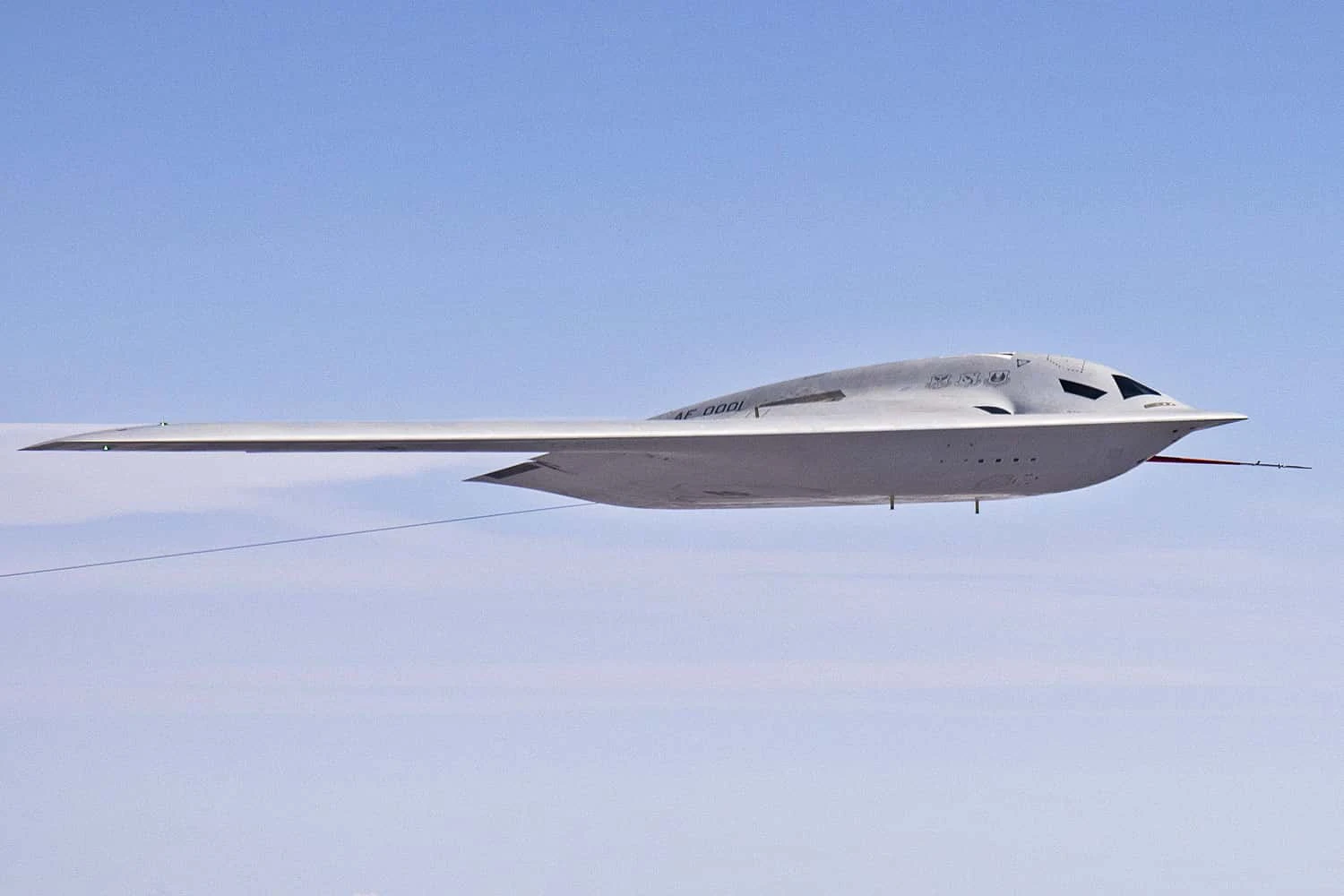
The U.S. Air Force is studying the possibility of giving bombers an air-to-air combat role, an unusual concept that could eventually allow aircraft such as the B-21 Raider to engage enemy aircraft without operating as conventional fighters.
The proposal appears in a report on the future fighter force submitted to Congress in October. According to Air & Space Forces Magazine, the document lists “developing air-to-air capabilities on bombers” among options being considered as the service examines how to meet its future combat-aircraft requirements.
The Air Force estimates that it will need 1,509 aircraft coded for fighter missions by 2035, compared with 1,288 today. Budget and production constraints, however, could make it difficult to reach that number exclusively through aircraft such as the F-35A, F-15EX and future F-47.
Using bombers for some air-to-air missions is one of the alternatives under study, alongside greater use of Collaborative Combat Aircraft (CCA) and potentially another fighter design.
Follow Air Data News: WhatsApp | Instagram | LinkedIn | Twitter | Facebook
The report does not identify the B-21 as the aircraft that would receive the capability, nor does it establish a program to arm the Raider with air-to-air missiles. But previous Air Force discussions show that the service has already considered a larger role for stealth bombers in air superiority missions.

Not a B-21 fighter
Such a mission would be fundamentally different from using the B-21 as a fighter. The Raider is a large, subsonic stealth bomber and was not designed for the speed, acceleration and maneuverability associated with traditional air combat.
Long-range weapons and networked sensors, however, increasingly separate the aircraft detecting a target from the aircraft launching the weapon.
A bomber could therefore operate as a stealthy weapons carrier, receiving targeting information from fighters, CCAs, airborne sensors or other platforms and launching air-to-air missiles without having to approach an enemy fighter for close combat.
Recent news


October 24, 2026

The concept would exploit characteristics that are already central to the B-21: long range, low observability and a large internal weapons capacity. Instead of carrying only a handful of air-to-air weapons like a stealth fighter, a bomber could potentially serve as an airborne arsenal, although the payload and internal weapons-bay capacity of the B-21 remain classified.
The Air Force has also explored much longer-range air-to-air weapons. A recent request for information sought concepts capable of reaching targets at distances of at least 1,000 nautical miles, or about 1,850 km. A weapon in that class would radically change the relationship between the speed of the launching aircraft and the range at which an engagement could begin.

Sensors somewhere else
The concept also fits the Air Force’s move toward distributed combat networks. An F-47, F-35, CCA or another sensor could detect and track an aircraft while a bomber positioned elsewhere supplied the weapon.
That would allow a B-21 to contribute to air superiority without necessarily using its own sensors to find the target or exposing itself by approaching it.
CCAs could make the arrangement even more flexible. Air Force Global Strike Command officials have previously discussed the possibility of long-range collaborative aircraft accompanying bombers, extending their sensing, communications and defensive capabilities inside contested airspace.
The same architecture could also provide protection against unmanned aircraft and other airborne threats. Rather than relying exclusively on stealth to avoid interception, future bombers could have weapons capable of destroying threats approaching the formation.
The idea is not entirely new. The U.S. military has examined “arsenal plane” concepts in which a large aircraft carries substantial numbers of weapons while other platforms provide targeting information. A stealth bomber would add the ability to move such an arsenal considerably closer to defended airspace.
The Air Force has not disclosed which bombers it could use for the proposed air-to-air capability, what weapons they would carry or whether the concept will proceed to an acquisition program. The B-21 is still entering service as the centerpiece of the future U.S. strategic bomber force, while the B-52J is expected to remain in operation for decades.