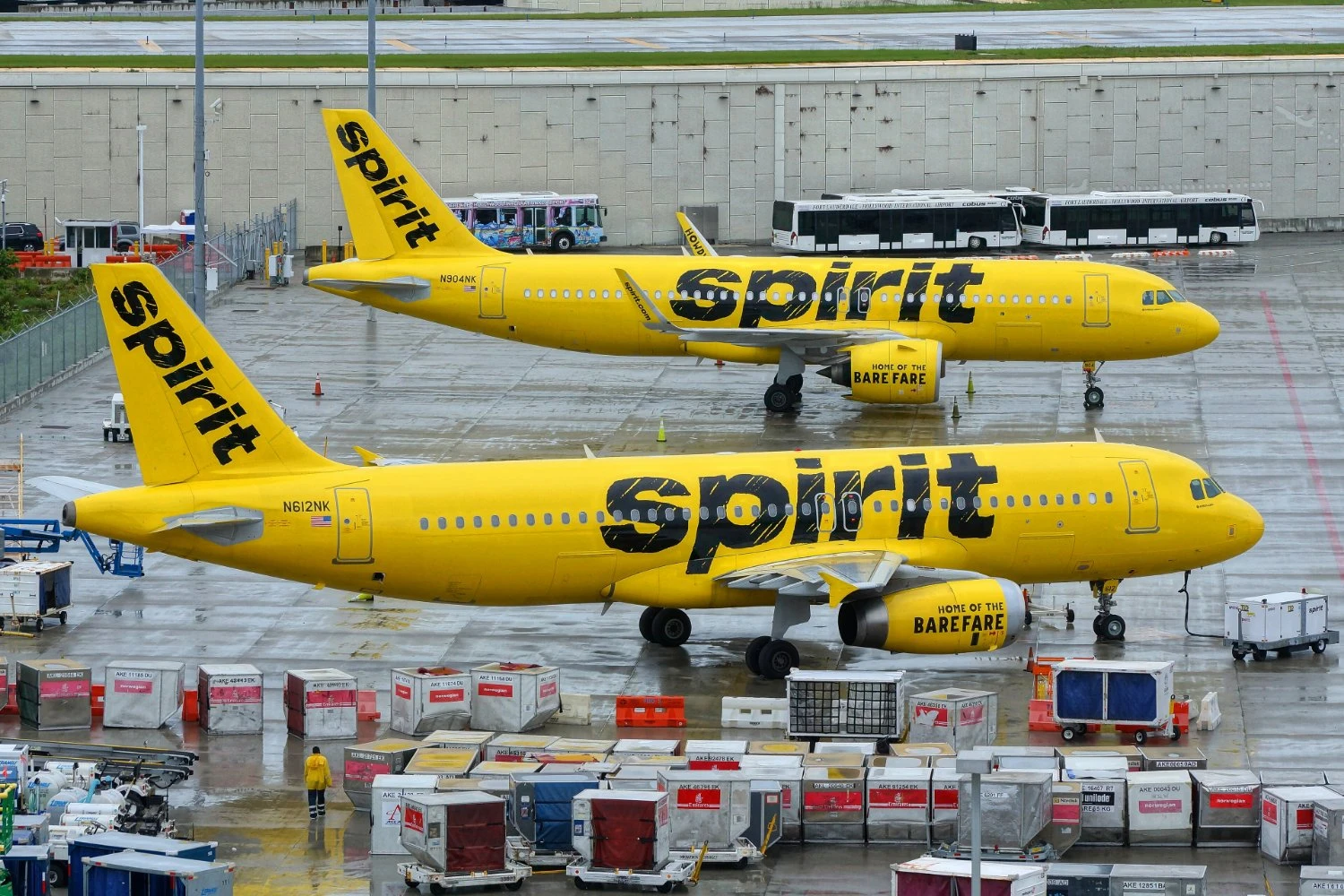
Spirit Airlines’ aircraft are already being sold or returned to lessors following its shutdown. Now even the defunct carrier’s emails, internal messages and business documents have found a buyer.
Google won a bankruptcy auction for a large collection of Spirit’s corporate data and proprietary software, agreeing to pay US$10 million for material it intends to use for product development and artificial intelligence training.
Follow Air Data News: WhatsApp | Instagram | LinkedIn | Twitter | Facebook
The unusual package includes about 100 million employee emails and 500 million Microsoft Teams messages, according to bankruptcy court filings. Calendars, spreadsheets and other documents covering subjects such as airline operations, marketing and employee productivity are also included.
Passenger information is excluded from the transaction. Google said it will not receive customer profiles, loyalty program data or credit card information, and personally identifiable information must be removed before the material is transferred.
Google initially offered $5 million for the assets. AI data company Mercor subsequently bid US$7.5 million before Google increased its offer to US$10 million and won the auction.
The sale still requires approval from the US Bankruptcy Court for the Southern District of New York, with a hearing scheduled for August 19.
From major low-cost airline to liquidation
Spirit’s enormous archive is a byproduct of a company that operated for decades and, until recently, ranked among the largest ultra-low-cost carriers in the United States.
The airline built its business around an aggressively unbundled fare model and operated an all-Airbus A320-family fleet. Its rapid expansion during the previous decade eventually left it with more than 200 aircraft and substantial commitments for additional A320neo-family jets.
Spirit’s financial position deteriorated after the pandemic, however. Pratt & Whitney PW1100G engine problems also forced numerous A320neo-family aircraft out of service, depriving the airline of capacity at a particularly difficult time.
An attempted US$3.8 billion acquisition by JetBlue Airways offered Spirit a possible exit, but the deal was blocked by a federal judge in January 2024 on competition grounds. JetBlue abandoned the transaction two months later.
Spirit filed for Chapter 11 bankruptcy protection for the first time in November 2024 and emerged in March 2025 after restructuring its debt. The recovery was short-lived. The airline returned to Chapter 11 in August 2025 and began progressively reducing its fleet.
As recently as March this year, Spirit still expected to survive. A restructuring proposal called for a fleet of only 76 to 80 aircraft by the third quarter of 2026, roughly one-third of the size it had when it entered its second bankruptcy proceeding.
Those plans collapsed within weeks. Spirit announced on May 2 that it had run out of viable financing after another deterioration in its financial position, aggravated by higher fuel prices. All flights were canceled and the airline began an orderly wind-down.
Spirit had 114 Airbus A320-family aircraft when operations ceased, including 66 leased jets and 48 owned aircraft. The bankruptcy process has since turned to selling aircraft and other remaining assets to recover money for creditors.
That process has now reached assets that would ordinarily disappear with an airline. Instead of being discarded, years of internal communications and operational records have acquired value for an entirely different industry: training artificial intelligence systems on how a real company worked behind the scenes.