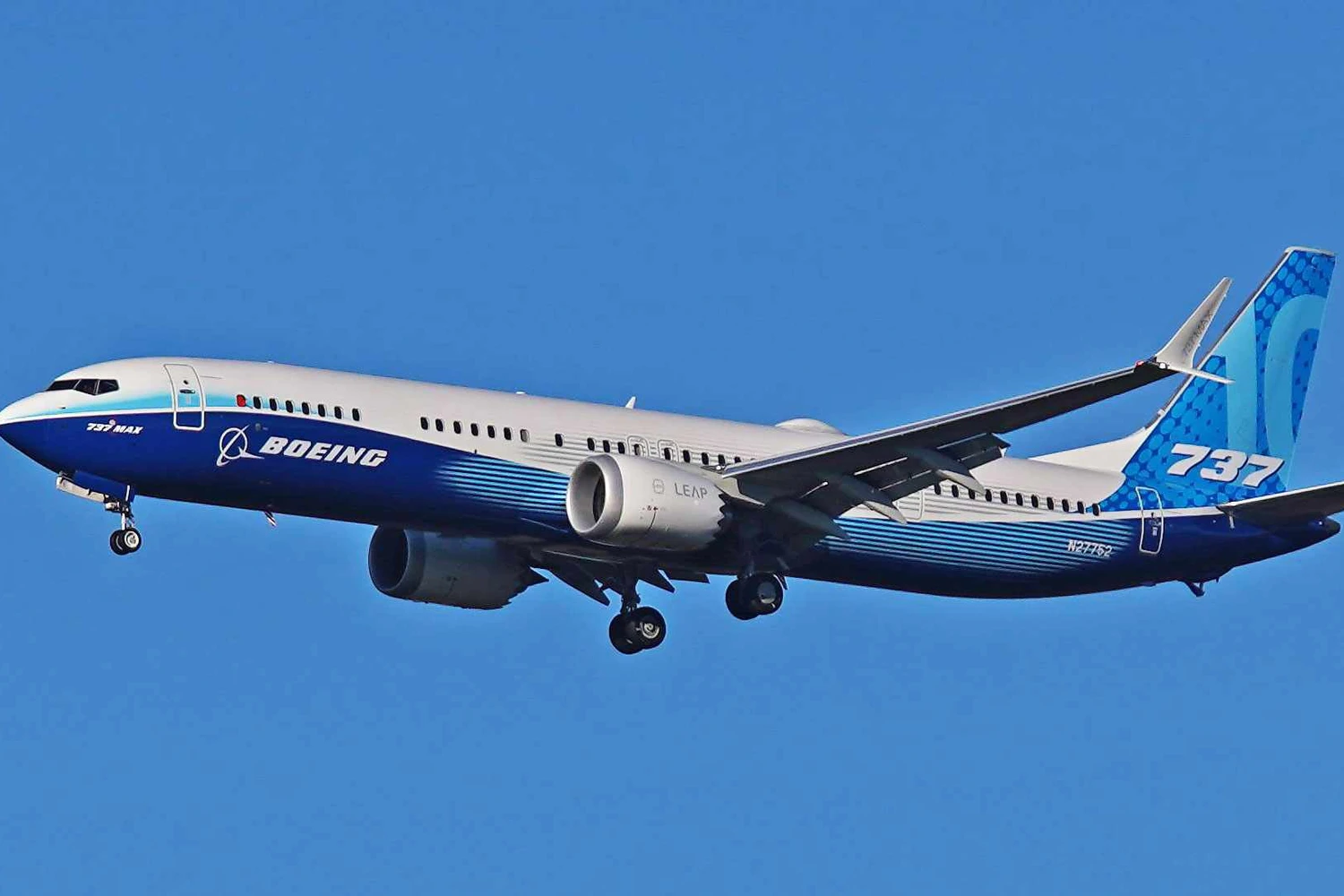
The largest Boeing 737 ever built has received approval to enter commercial service. The Federal Aviation Administration (FAA) certified the 737 MAX 10 on Tuesday, allowing Boeing to begin deliveries of an aircraft capable of carrying up to 230 passengers.
The MAX 10 stretches 143 feet 8 inches (43.8 meters), about 5 feet 5 inches (1.7 meters) longer than the MAX 9. It is also considerably larger than the original 737-100, which entered service in 1968 with a length of just 94 feet (28.7 meters).
The longer fuselage also forced Boeing to develop a unique semi-levered main landing gear for the MAX 10. To provide enough tail clearance during takeoff rotation without enlarging the existing 737 wheel wells, the gear extends by about 9.5 inches (24 cm) and then shortens as it retracts, allowing it to fit within the existing structure.
Boeing developed the MAX 10 to compete at the upper end of the single-aisle market. In a typical two-class configuration, it accommodates 185 to 210 passengers, while its maximum-density configuration increases capacity to 230.
The aircraft has a range of 3,100 nautical miles (5,740 km). Its principal competitor, the Airbus A321neo, can accommodate up to 244 passengers and has a range of around 4,000 nautical miles (7,400 km) in its standard version.
Follow Air Data News: WhatsApp | Instagram | LinkedIn | Twitter | Facebook
FAA approval also clears a substantial delivery backlog. Boeing has received orders for 1,555 MAX 10s from more than 30 customers, representing more than 30% of the current 737 MAX order book.

WestJet is expected to become the first airline to receive the aircraft. The Canadian carrier has 60 MAX 10s on direct order from Boeing and agreements for another 13 through Aviation Capital Group.
Deliveries can begin in the coming months, according to Boeing. Ryanair, another major customer, expects to receive its first 16 aircraft in early 2027.
New safety requirements
The MAX 10 became the first commercial aircraft certified under the full requirements of the Aircraft Certification, Safety, and Accountability Act (ACSAA), legislation adopted in the United States in 2020 following the two fatal MAX 8 accidents.
The certification required additional documentation of safety assessments and human factors evaluations. Boeing said the process generated tens of thousands of pages of documentation and included more than 2,000 flight-test hours and approximately 1,000 hours of ground testing.

Among the changes incorporated into the MAX 10 is an enhanced Angle-of-Attack (AoA) system designed to provide additional protection against erroneous sensor data and reduce pilot workload. Boeing plans to make the system standard across the MAX family.
The FAA issued an amended type certificate for the MAX 10 and updated Boeing's Production Limitation Record, allowing the manufacturer to produce the variant for delivery to customers.
The decision also completes certification of the 737 MAX family. The smaller MAX 7, the other variant that had remained in development for years, received FAA approval on August 3.
