Five Boeing 777s that reached Iran under unusual circumstances in July 2025 are at the center of a criminal case in Madagascar involving former government officials, aviation authorities and businessmen.
The aircraft, all Boeing 777-200ERs previously operated by Singapore Airlines and later NokScoot, appeared on the Malagasy register shortly before their transfer to Iran. Their movements attracted international attention after the jets flew from Cambodia toward the Middle East and disappeared from public flight-tracking services before arriving in Iran.
A new investigation by Agence France-Presse (AFP), based partly on documents from the criminal case, reports that 28 people face proceedings in Madagascar over the operation. The case includes allegations of corruption and improper authorization of the aircraft registrations. The defendants contest several of the accusations.
The court proceedings provide a new chapter to a transfer that had already drawn scrutiny from authorities in Madagascar and the United States because Iran has been subject to restrictions on acquiring Western-built commercial aircraft.
Five former Singapore Airlines 777s
The five aircraft were built as Boeing 777-212ERs and originally delivered to Singapore Airlines. They later moved to Thai low-cost carrier NokScoot, which ceased operations in 2020.
After several years without regular airline service, the aircraft surfaced again in 2025 with registrations from Madagascar despite having little apparent operational connection with the African country.

The jets were registered 5R-RIS, 5R-ISA, 5R-HER, 5R-IJA and 5R-RIJ. Their appearance on the Malagasy register preceded their departure from Cambodia on July 15.
Flight-tracking data showed the aircraft heading west before their transponders stopped transmitting while crossing the region around Afghanistan. They subsequently emerged in Iran.
The unusual flights quickly raised questions about whether the Malagasy registrations had been used as an intermediary step to move Western-built aircraft into the country.
U.S. authorities later identified the five 777s as aircraft transferred to Iran in violation of U.S. export restrictions. The U.S. Department of Commerce said the jets contained U.S.-origin components and were subject to Export Administration Regulations.
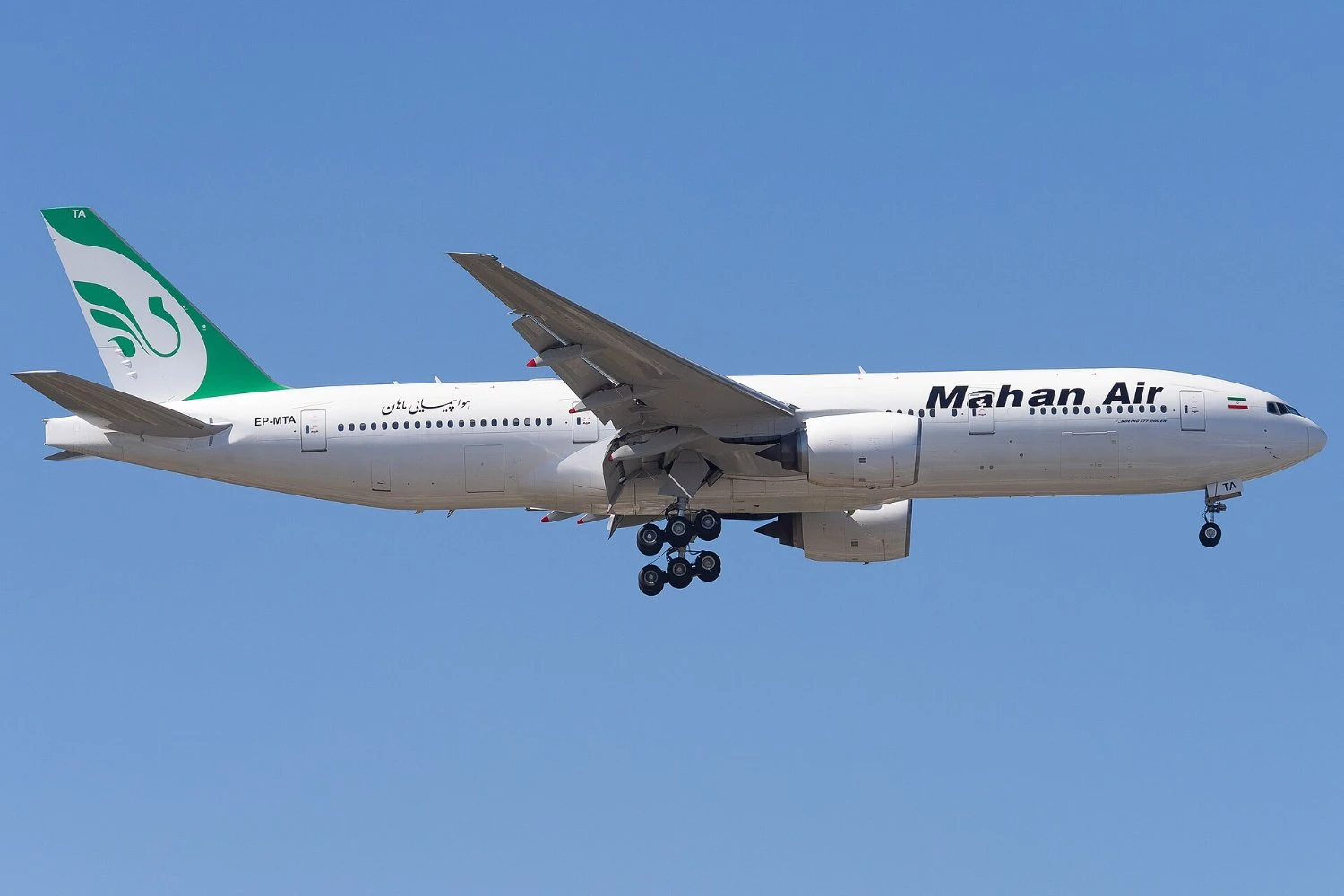
The aircraft later received Iranian registrations after joining Mahan Air, with the 777s mainly deployed on international routes from Tehran. EP-MTA, for example, has recently flown mostly to China, along with services to destinations such as Phuket. One of the five, EP-MTC, was destroyed at Mashhad in March 2026 during the U.S.-Israeli attacks on Iran.
A familiar route around sanctions
Iranian airlines have relied heavily on the secondary market to obtain aircraft because sanctions have prevented them from buying most new Airbus and Boeing jets directly.
Transactions have frequently involved intermediaries, temporary registrations and ownership structures in third countries. Aircraft can change operators or registrations several times before reaching Iran, making their final destination difficult to establish during earlier stages of a transaction.
The five 777s were notable because they represented a substantial addition of large long-haul aircraft in a single operation.

See also: Saudia denies selling former Boeing 777-200s to Iran
Iran has accumulated fleets of older Airbus and Boeing aircraft through similar secondary-market acquisitions, but the 777 provides considerably greater long-haul capability than many of the aircraft obtained by Iranian operators in recent years.
The identity of their eventual Iranian operator was initially unclear. Mahan Air, one of Iran's largest privately owned airlines and an operator subject to U.S. sanctions, was repeatedly linked to the aircraft after their arrival.
The Madagascar case is now shifting attention away from the flights themselves and toward the mechanism that allowed the aircraft to acquire registrations before reaching Iran.
Proceedings involving the transfer are scheduled to resume in Madagascar on October 27.